IMPACT OF THE HAPPY HORSE PROGRAM ON EQUINE COGNITIVE DEVELOPMENT
Having worked for several years within Equideo, with the Happy Horse program, created in 2021 by Linda Parelli, I have observed a fascinating phenomenon: it seems that the horses that engage in it develop not only greater precision in their communication, but also a cognitive and emotional acuity that seems to go far beyond what is observed in horses that, on the one hand, are either simply left to roam freely with their peers, even in an environment that is perfectly respectful of their basic needs, and on the other hand, are horses that have had very high-level training, both technically and relationally, through other ethical education programs, but which lack brilliance and presence of soul in their expression.
Before dedicating myself fully to horses, I practiced as an osteopath for humans. My approach was not limited to manual techniques: I was passionate about understanding the deep mechanisms that connect the body, emotions and the brain.
This is how I deepened my knowledge of psychology and neuroscience, to understand how experience, environment, and relationships influence the very structure of the nervous system, behaviors, postures, and functions, and subsequently, through a chain reaction, the dysfunctions, blockages, and pains that lead a patient to seek help. It was even more fascinating working with athletes, observing the details and impact of the same refined but repeated movement on their bodies (what many today call motor preferences; I was studying their medium- and long-term consequences and impacts).
When I started learning Linda Parelli's Happy Horse program and developing it with my horses, I found almost identical principles in the relationship with the horse:
- Brain plasticity allows for the creation of new connections and new skills.
- The decisive impact of the quality of the relationship on the ability to learn and manage emotions: the bond, this powerful connection naturally created which is the foundation and the power of this program.
- The role of targeted conversation in developing the horse's precision, coordination, and adaptability to humans, and vice versa, so that a true two-way conversation can occur.
By applying my human knowledge to working with horses, I've been able to observe and analyze how, session after session, horses enrich their "body vocabulary," refine their perception, and become more creative partners. But above all—and this is the first major point—they become more aware and more involved in the relationship, in the exchange. A new presence emerges, and especially a new perspective, a new energy. Everything is deeper, brighter, more intense. This approach doesn't just improve performance or well-being in the short term; it seems to transform the very structure of their brains, offering them a cognitive opening that influences their entire lives. Their capacity for analysis and reflection appears to be significantly enhanced.
In horses, as in humans, the brain retains a certain capacity for remodeling throughout life, called neuroplasticity. Like a muscle, the brain is capable of developing its function.
Studies (Hanggi et al., 2010; Lansade et al., 2017) show that enriched environments—that is, those offering a diversity of sensory, motor, and social stimulation—improve memory, problem-solving, and cognitive flexibility. Letting a horse live its "horse life" in a herd, with space, grass, water, and quality social interactions, is an essential foundation. It's the equivalent, for a human, of having a safe home and a healthy diet. But I observe that the equine brain can develop much further. The natural environment, however essential, doesn't allow us to exploit the full potential of their brains. Indeed, in the wild, horses learn to meet the demands of survival and social life: reading the intentions of another horse, detecting danger, finding food. It's a rich language, but one that remains limited to these basic needs.
I am discovering that the Happy Horse program opens up another dimension: that of voluntary and shared cognitive stimulation with humans. By introducing structured, varied, progressive and thoughtful interactions — groundwork with the rope according to the principles of Connection, Comfort and Choice, then free work, precision conversation, reading micro-signals of the body, problem-solving — we offer the horse challenges that call upon its memory, its ability to anticipate, its behavioral flexibility, and above all its free choice of propositions and expression of ideas, opinions and emotions.
This process literally transforms his “inner vocabulary”:
- The horse's micro-responses (muscle tension/relaxation, variations in breathing, ear orientation, gait adjustment) are recognized and valued.
- He no longer simply reacts; he initiates.
- He no longer passively experiences a situation; he evaluates it and proposes solutions.
- It develops nuances of communication impossible to express if the former are not perceived or valued: a subtle change can provoke a subtle response from the human — and vice versa.
- He actively seeks dialogue, no longer to obtain a tangible reward, but for the INTELLECTUAL AND EMOTIONAL SATISFACTION AND SERENITY OF THE RELATIONSHIP THAT RESULTS FROM IT.
- He finds meaning in everything he does with his human because he has learned that Comfort and Choice are constantly present
What are the impacts and consequences that result from these observations?
I've delved deeper into my research and reflection, and I recently came across two very interesting experiences. The first is this: I wanted to prepare one of my very sensitive horses for a dressage clinic taking place two weeks later. It was the end of August. In the South of France, with the intense summer heat we now experience, and the increasingly powerful and prolonged heatwaves, the organization of the horses' work is severely disrupted. It's out of the question for me to ask even a trained horse to exert itself in temperatures above 33 degrees Celsius. This is a personal choice I adhere to. It means choosing which horses are in work, which are being developed, which are learning, what types of sessions to plan, and so on. It also means that I can only properly ride four horses a day before the extreme heat sets in. With this Happy Horse program, so rich in mental and emotional development, I was only able to ride this notoriously sensitive horse, I think, five or six times all summer. The rest of the time, the sessions were on the ground or at liberty, and he probably only went out two or three times. I have about a dozen horses to develop (both my own and those I work with), not counting the lessons and clinics that are part of my schedule. The rest of the time, my horses live in a herd outdoors in an environment designed to optimize their thinking, interactions, and physical fitness thanks to the varied terrain, etc. This sensitive horse, who previously would have needed very regular training, showed an impressive mental and emotional readiness after so few sessions. And I've noticed this with all the horses developed in this program. The conversation can be picked up right where it left off, with the quality intact, demonstrating its intellectual impact.
Let's delve deeper into the impacts and consequences for the equine industry:
This program leads to:
- The societal acceptance of horse riding, and more broadly, of equestrian sports
- A program that develops both humans and horses
- The possibility of reconciling mental, emotional and physical well-being in high performance
Let's elaborate on these three points:
- Societal acceptance of horseback riding: Science, awareness, and performance are the future of equine training
We are living in a pivotal era. Never before has equestrianism been so questioned, criticized, and scrutinized. Images of misunderstanding or coercion now elicit immediate disapproval. And that's a good thing. Because if we want equestrianism to still have its place in tomorrow's society, we must be willing to rethink it—fundamentally.
The horse is no longer a tool, nor a means of domination or sporting success. It is recognized as a sensitive, intelligent, and emotionally complex being. And this recognition changes everything: our methods, our objectives, our attitude.
The future of equestrian sport depends on our ability to combine three fundamental forces:
- Science, to understand, to explain what can be explained
- Awareness, to respect, to communicate, to grow
- and performance, to elevate.
- Science: understanding to train better
Knowledge about the equine brain, its plasticity, and its cognition has advanced dramatically in the last twenty years. The work of Hanggi, Lansade, Murphy, Sankey, and many others has shown that the horse is not a reactive animal but a cognitive being, capable of memorization, deductive reasoning, emotional intelligence, and even subtle social adjustment. These discoveries necessitate a reassessment of the "training" paradigm as it has long existed.
One can no longer talk about equine education without talking about:
- neuroplasticity (the brain's ability to remodel itself),
- emotional regulation,
- Contextual learning,
- intrinsic motivation,
- interspecies communication.
The Happy Horse program is directly in line with this scientific approach. It is based on understanding the workings of the limbic brain, observing motor responses as reflections of emotional state, and creating an enriched learning environment—cognitive, social, and sensory. In this way, science becomes the foundation of modern riding: rigorous, measurable, and adaptable.
- Consciousness: understanding is not enough, one must transform oneself
But knowledge alone is not enough. What distinguishes the Happy Horse program approach, as we practice it at Equideo, is the central role given to awareness—the horse's, of course, but also the human's. Understanding the equine brain only makes sense if the human learns to regulate their own. Awareness of their energy, awareness of our movements that are always too quick, too noisy, or too abrupt, awareness of our breathing, awareness of our emotions (state of mind, mood, etc.). Awareness of our intentions, our posture, the clarity of our plan—these are elements taught nowhere else with such high quality and precision. The horse is not trained through force, but through the emotional and postural coherence of its partner.
Thus, consciousness is not an abstract concept: it is a neurophysiological skill that is cultivated through:
- stress regulation,
- attention to breath and body,
- the clarity of one's own emotions,
- the ability to perceive before intervening, etc.
Awareness transforms the rider into a guiding force rather than a trainer. It paves the way for a partnership in horsemanship, where every interaction becomes an act of listening, adjustment, and shared growth. It is this awareness that makes riding acceptable—because it places the horse's dignity at the heart of the practice, without sacrificing the rigor or exacting standards of equestrian art.
- Performance: Redefining to Give New Meaning
For too long, performance has been confused with the domination of the body or the pursuit of results at any cost. The performance of the future will no longer be measured by the strength of the gesture: it will be measured by the subtlety of communication, the fluidity of shared movement, the emotional stability of both partners, and the expression of the couple.
Performance is no longer a striving for results, but a harmonious expression of two cooperating nervous systems. It emerges naturally when science illuminates the method, and conscience guides the practice. It is the symbiosis of these three pillars—science, conscience, and performance—that creates sustainable, fair, and inspiring horsemanship.
- Towards a new societal acceptance
Modern society will no longer accept horseback riding if it remains based on constraint or blind tradition. It will accept it, however, if it becomes a model of relational intelligence, emotional education, and cognitive innovation. In other words: if it becomes an art conscious of life, a shared excellence.
The horses are already ready. Their brains, their sensitivity, and their willingness to cooperate only require a fair and evolving framework like the innovative spirit of the Happy Horse program. It is up to us, humans, to align ourselves with this new level of awareness. The riding of the future will be neither "ethological," nor "classical," nor "natural.".
- A program that develops both horses and humans
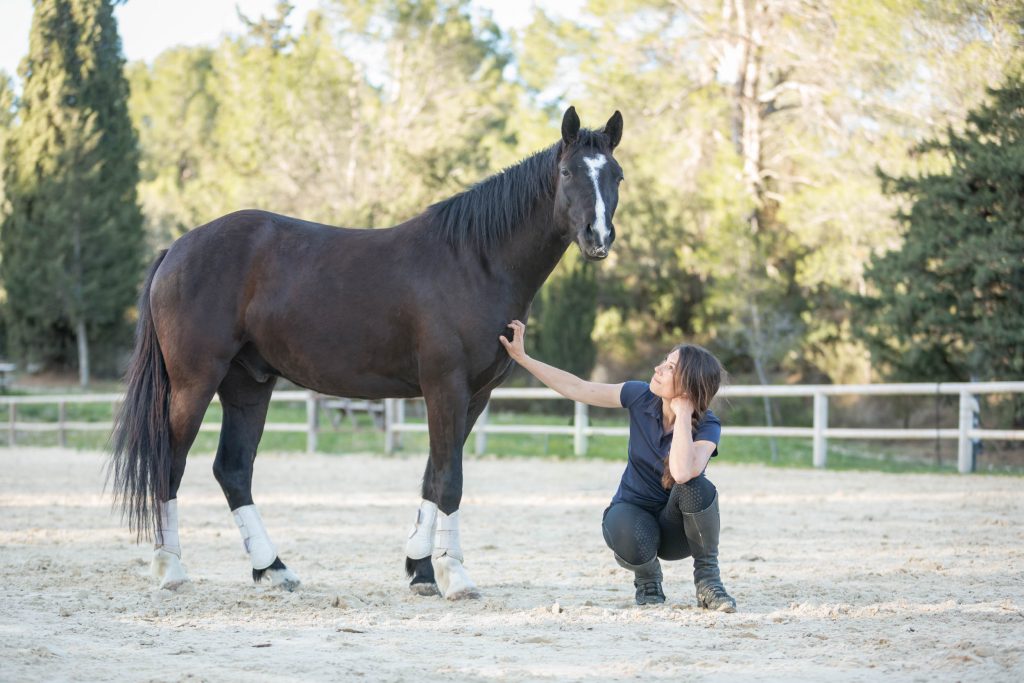
The Happy Horse program is not just a training program for the horse. It is a personal transformation for the human. For a horse to evolve, the human must first be self-aware and develop personally—in their body, their emotions, and their way of thinking. The program demands a quality of presence, consistency, and clarity from the rider that no technical exercise can compensate for. The horse only truly develops when its partner becomes capable of mastering their energy, intention, and emotional regulation. It can only learn calmly if the human embodies that calm. It can only explore with curiosity if the human ceases to be afraid of doing things wrong.
This is why the Happy Horse program acts as a continuous inner training, a true developer of being well before it is of doing. My students all tell me unequivocally how comprehensive the program is and how much they have learned about themselves. Even their friends and families tell me they have seen them transform, and for the better. Every interaction becomes an opportunity to learn to slow down, listen, breathe, observe, and adjust.
To be understood by the horse, you must be precise.
To be precise, one must be clear-headed.
And to be clear-headed, one must be internally available.
Over the course of the sessions:
- The rider refines their body and emotional awareness.,
- He develops a more stable attention span.,
- He learns not to react, but to respond.,
- He replaces control with conversation by asking a question that awaits and listens for an answer.,
- and he discovers that the horse's progress depends directly on its own quality of conversation.
The Happy Horse method requires the rider to prioritize awareness over action. Before moving a hand, pulling a rope, or changing gait, they must know what they want to communicate, why, and how. This requirement develops a rare attentional intelligence: the rider learns to think before acting, to adjust before correcting.
Communication becomes a matter of the quality of intention:
- A vague thought creates confusion.
- Too strong an intention generates pressure.
- A clear, breathed and congruent intention invites the horse to cooperate.
This requirement transforms the way we behave, think, and even breathe. By striving to improve our horse, we ultimately improve ourselves. For a horse to thrive, the human must learn to become a true space of safety and clarity, thanks to their knowledge of the horse's mental and emotional needs, the use of appropriate practical strategies, and also by developing a high level of self-awareness.
Through the slowness, observation, and precision of the Happy Horse exercises, humans retrain their own nervous system. I highly recommend reading the latest research and publication by Dr. Ann Hemingway and her team on the incredible results of the Happy Horse program in supporting families with multiple communication problems, when speaking is no longer possible.https://www.academia.edu/2997-9196/2/4/10.20935/MHealthWellB8071).
Humans learn to regulate their automatic responses, to identify subtle signals, to breathe instead of reacting. These skills aren't limited to equestrian work; they extend to all of life. The horse then becomes a partner in personal growth, not because it teaches, but because it never lies.
The Happy Horse program thus develops a more intelligent, more connected, more conscious horse. But above all, it develops a more just human, capable of providing their horse with the conditions necessary for its full potential to flourish.
- Equine Performance and Well-being are possible
Could the development of cognitive abilities have a direct impact on longevity and athletic performance?.
Why this idea?
- A stimulated and curious brain maintains better neuronal plasticity, which, in many species, is associated with slower aging and better adaptation to change.
- A horse that knows how to manage its emotions and finely read its environment is less prone to chronic stress, which reduces physiological wear and tear and the risk of stress-related pathologies.
- The diversity of motor and mental stimulation optimizes proprioception, coordination and motor learning capacity — all assets for prolonging a high-level sports career.
- The mutual trust created by this rich dialogue reduces the risks of accidents or defensive behaviors that can prematurely interrupt a sporting career.
In summary, the Happy Horse program does not simply “make the horse happy”: it expands its awareness and skills, develops a genuine appetite for reflection and collaboration, and can — if these observations are confirmed — contribute to a longer, healthier and more fulfilling career.
Conclusion: Is the Happy Horse program an accelerator and amplifier of equine cognitive development?
Just like in humans, once the brain has experienced this richness, it doesn't want to go back. The horse becomes an active participant in the relationship, a partner in the process, and the architect of its own progress. This is all the more rewarding because by providing my horses with a very rich and varied environment—living in a herd, with unlimited hay under small-mesh hay nets or in pastures depending on the season, and outdoors year-round—they deliberately come to the gate and are very interested to find out what new activity we'll be doing that day as soon as I arrive with a halter. This is especially interesting because I don't give any food rewards associated with putting on the halter, and the horses don't know in advance what they'll be doing with me that day.
What I discover day after day is that this program doesn't just transform the way we work with horses; it seems to truly transform the very nature of their brains by developing their cognitive abilities and, potentially, their entire life trajectory. This, perhaps, is the most powerful impact: training horses who want to think with us, not because they are forced to, but because shared thinking has become, for them, a source of pleasure, shared interests, and serenity.
Useful references:
- Hanggi EB, Ingersoll JF, Wagoner TL. Equine learning and cognition: the known and unknown. Behav Processes. 2010.
- Lansade L et al. Impact of environmental enrichment on the behavior and physiology of horses. Appl Anim Behav Sci. 2017.
- Murphy J, Arkins S. Equine learning behavior. Behav Processes. 2007.
Article written by Sarah Fricoteaux, manager of the Equideo Education Centre
If you would like to learn more about our programs, please visit this link: https://app.equideo.fr/
Did you enjoy this article and want to learn more? Follow this link and gain a fresh perspective on horses, riding, and equestrian sports, developing greater self-expression and a stronger relationship!
